Theory of Change
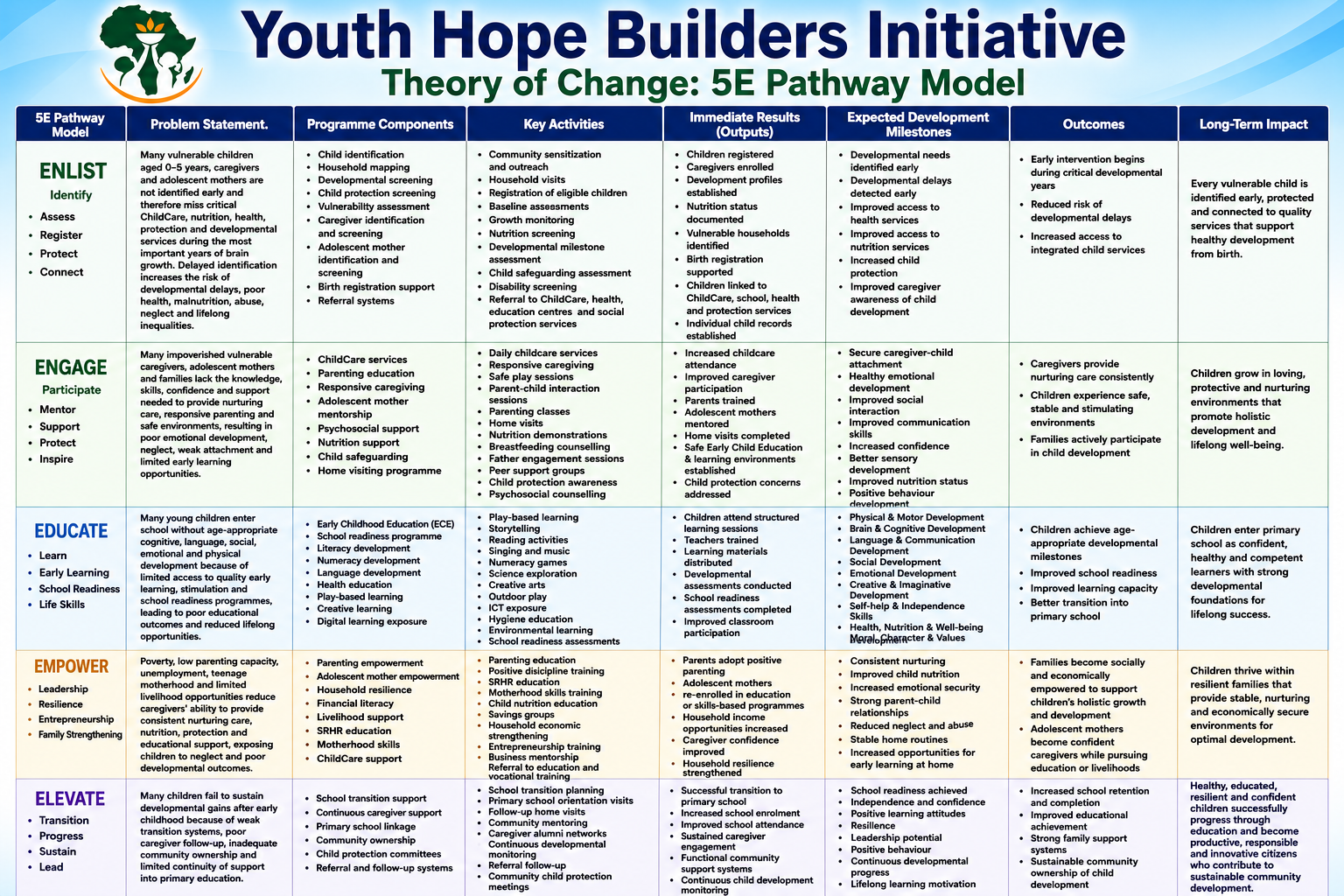
Youth Hope Builders Initiative (YHBI), through its Y-CARE Programme, believes every African child and young person deserves the opportunity to survive, learn, thrive, and reach their full potential. Our 5E Model Theory of Change is that when vulnerable children, impoverished caregivers, and adolescent mothers are identified early and supported through integrated, community-led interventions—including nurturing childcare, quality early childhood education,
health, nutrition, protection, research, innovation, skills development, and economic empowerment—while engaging families, communities, governments, and development partners, they develop the knowledge, resilience, and opportunities needed to succeed. This life-course approach strengthens families, promotes sustainable livelihoods, builds resilient communities, breaks intergenerational cycles of poverty and inequality, and contributes to Africa’s Agenda 2063 and the Sustainable Development Goals (SDGs).
The Central “Why”
Why will the 5E Pathway Theory of Change Model work?
Because the development of children, adolescents, adolescent mothers, and youth is influenced by multiple interconnected factors, including health, nutrition, protection, education, responsive caregiving, psychosocial wellbeing, family stability, economic resilience, and supportive community systems and Right skills development.
When vulnerable children, adolescents, adolescent mothers, and youth are identified early (Enlist), engaged through nurturing care, mentorship, participation, and protection (Engage), provided with quality early learning, education, life skills, research, innovation, and skills development opportunities (Educate), supported by empowered, resilient families and economically strengthened caregivers (Empower), and guided through successful transitions with continuous community support, leadership opportunities, and lifelong learning pathways (Elevate), they are more strengthened to survive, thrive, learn, lead, and achieve their full potential.
This integrated, evidence-based approach produces lasting
improvements in child and adolescent wellbeing, educational achievement, youth empowerment, family resilience, and sustainable community development.